
Welcome to our speaker section
We have a number of specialist presenters coming from numerous professional and academic areas. Please the list below for the abstracts and grouping during the day.
For the Programme – Click Here or scroll to the end of this list
Parallel Sessions / Workshops-
Our speaker sessions will all be held in the Debates Chamber, while our workshops will be held in parallel in two locations: the Debate Chamber and the Reading Room.

Session 1:
Lived Experience & Co-Production in Research
- Speaker Group A –Christian Jessen Hunter, Craig Houston, Mx PJ
- Title: Experts by Experience and Co-Producing Research in Marginalised Population Groups
- Speaker Group G – Dr Camila Biazus Dalcin, Professor Alison McFadden
- Title: Dissemination of the Community Health Worker Service Evaluation in Scotland: Engaging with Gypsy/Travellers Using Stop Motion Animation
Inclusive Research & Public Engagement
- Speaker Group J – Susan Grant (Byres Hub) and Jane Cowie (Annexe)
- Title: Physical Activity with Partick Communiversity: Training Peer Researchers
- Speaker Group K – Andy Steele & Fiona Strachan (Tracy Ibbotson in absenta)
- Title: Amplifying Diverse Voices: Using Large Language Models to Complement Public Involvement in Research
Session 2:
Patient Involvement & Healthcare Research
- Speaker Group H – Catriona Ewart
- Title: Exploring the Methodological Challenges of Using Photovoice in Adolescent Health Research: Experience of the Eyes Wide Open Sleep Study
- Speaker Group E – Dr Anthony Lockett, Dr Lindsay Park, & Dr Shams Al-Ani
- Title: Incorporating Disease Diversity in Patient Involvement
- Speaker Group B – Susan Grant, Dr Joana Carvalheiro
- Title: Integrating Lived Experience into Basic Neuroscience: How PPIE Shaped an Addiction Research Project
Policy, Health Inequalities & Systems Change
- Speaker Group J – Dr Ruth Lewis
- Title: Evaluating the Impacts of Public Involvement in Health Research: What Can Ripple Effects Mapping Offer?
- Speaker Group I – Dr David Maidment
- Title: Supporting Self-Management of Long-Term Health Conditions and Disabilities in the Workplace: The Development of the Co-Manage Toolkit
- Speaker Group N – Dr Andy Slovak
- Title: Public Participant Tale
Session 3:
Reflections on PPIE and Workers Inclusion
- Speaker Group C – Ian Tasker
- Title: Effective Voice and Occupational Health
- Speaker Group M – Jenna Ingram, Jane Ormerod
- Title: Reflections and Learning from the First 4 Years of Using Long Covid PPIE Flexibly and Productively in Research Activity
- Speaker Group L – Dr Sue Cole, Hussein Patwa, Dr Kathryn Martin
- Title: Lessons Learned from Having Patient Partners as Co-Investigators in the C-PICTURE Project
Workshop 1: Consortium Against Pain Inequality (CAPE) – Engaging and Encouraging PPIE in Practice
The UKRI- and Versus Arthritis-funded Consortium Against Pain Inequality (CAPE), within the Advanced Pain Discovery Platform, is investigating the impact of childhood adversity (ACEs) on chronic pain and responses to treatment later in life.
In this workshop, you will hear from experts by experience on how pain impacts on their lives and what being involved with research has meant to them. We will together explore the key elements in effective PPIE, consider the particular barriers that people living with pain experience in their voices being heard in research and discuss ways that these barriers can be overcome.
Workshop 2: Digital Engagement in Patient and Public Involvement and Engagement (PPIE) – A Practical Approach
PPIE is in an ever-changing approach to improving research practice. Post-pandemic, digital engagement has never been more widely expected or embraced. This digital renaissance has opened vast new avenues for communication, collaboration, and cooperation. Yet, the barrage of technical tools and expectations of digital capability has created new chasms of inequality for those unable or unwilling to “level up”.
In this workshop, we will discuss these challenges together. Led by members of the HWLG research team, we will together explore the key elements of effective digital PPIE, consider the particular opportunities and barriers unique to digital engagement, and discuss ways that these tools can be used fairly and effectively.
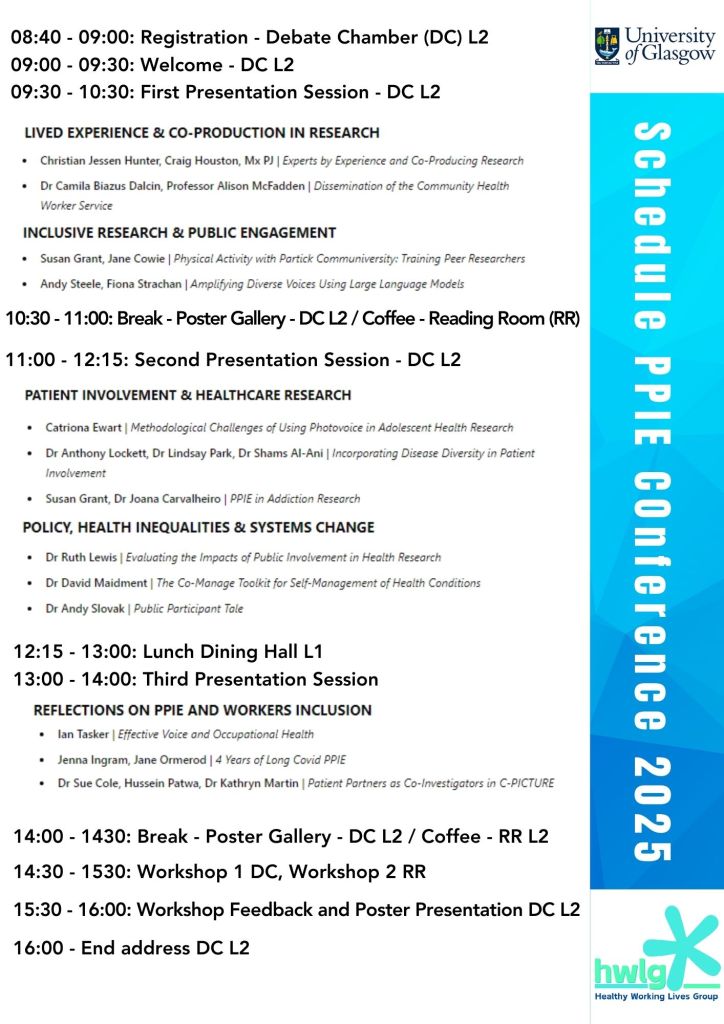

 Healthy Working Lives Group - PPIE Conference 2025